News -
Why summer is one of the best times to enjoy Iberian ham
Find out more

News published in Malaga Hoy (January 2, 2016):
http://www.malagahoy.es/provincia/cerdo-dorado-exclusivo-Serrania-Ronda...
Reproduction news:
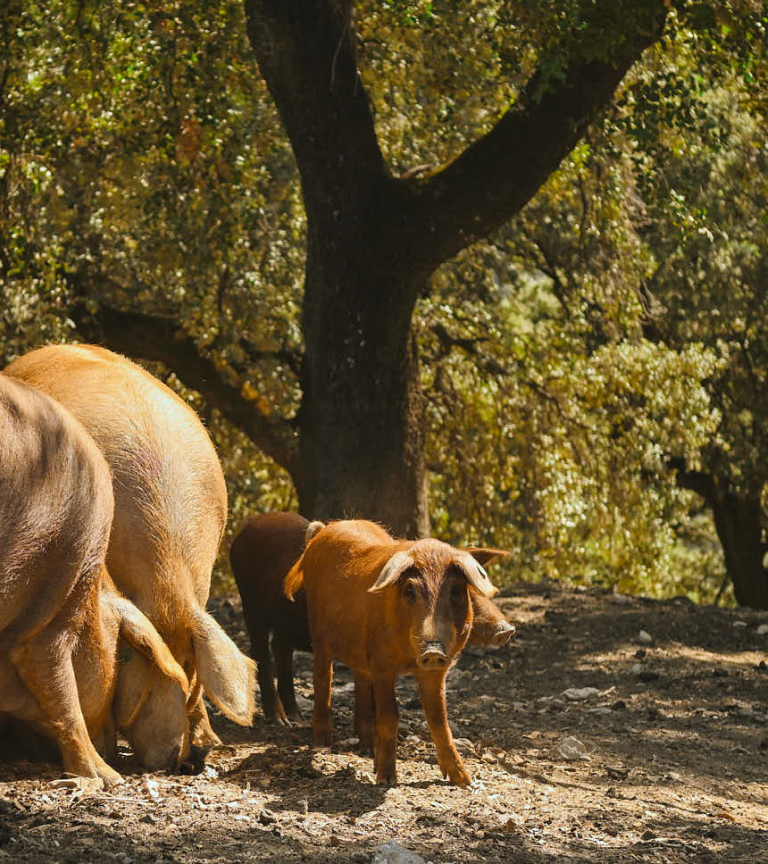
Considered to have disappeared, the orientation of production towards another type of variety and the plague were the main causes of their near extinction. Now the Iberian golden pigs will officially exist again from this January, when the Ministry of Agriculture reopens the genealogical book of the breeds and re-registers them, once their recovery has been confirmed. This is a small group of about 100 specimens that are preserved in the Ronda farm La Algaba, which was involved in 2011 in a project to recover this variety together with the University of Cordoba and the Provincial Council of Cadiz, which had already started an investigation in 2008.
After a few years, the golden Iberian pig may have a new opportunity to save itself from definitive extinction and become the fundamental basis for the production of one hundred percent Ronda's signature Iberian products, thanks to the involvement in this project of Consuelo Gámez, Professor of Economics at the University of Malaga, who has decided to bet on this species.
Gámez, after falling in love with the pastures of the Genal Valley on a visit with two of her students in the area, wondered why she had to eat good Iberian hams from other regions if the province of Malaga was such an appropriate place for their production. It was then that he decided to launch his project to create his own Iberian ham from the Serranía de Ronda, something he had already achieved with his own company. The Dehesa of the Monteross, with which it also produces other iberian signature products such as shoulders, loin, chorizo and salami, although it now intends to go a step further and ensure that they are the result of the breeding of a pig native to the region.
In addition, the scientific studies carried out so far point to the fact that this meat has improved Iberian qualities, as it has a greater infiltration of oleic acids and a greater presence of iron. However, now new tests are going to be carried out by the scientists of the University of Cordoba to determine the qualities of this meat, since it is planned to slaughter two golden Iberian pigs soon in order to compare their meat with that of two other Retinto and Entrepaldo pigs, which are currently used by Chelo Gámez to produce her Iberian products, which already reach countries such as Switzerland, England and Italy through different gourmet stores.
In addition, the professor from Malaga finds another added value to the fact of betting on these pigs, such as contributing to the fact that this species does not end up disappearing and can thus persist a type of pig that in the past was highly appreciated and is now reduced to a small number of specimens.
Meanwhile, Juan Terroba, owner of the small herd of golden Iberian pigs that managed to resist the adversities, is equally enthusiastic about the idea undertaken to prevent their extinction and convinced that Consuelo Gámez «is right» to bet on this species, since, as he explained, «the least it will do is to have products of the same quality, although I know that the meat will be better». Juan has had the opportunity to taste the meat of these pigs in some of the traditional slaughters he has carried out. «The meat is more tender», he assured, at the same time that he considered that the studies will demonstrate the improved qualities of these types of Iberian pigs.
Of course, the path that both have undertaken, assisted by the director of the regional agricultural office of the Junta de Andalucía in Ronda, Juan Luís Muñoz, is a long one. In fact, once the first two pigs have been slaughtered, the loins will not be ready until June and the shoulders will have to wait until 2017 to see their final result, while the hams will not arrive until 2018.
From that moment, if everything goes well, will begin a gradual increase in products made by this variety of pig to complete a total replacement of animals that will take years to be done. In the meantime, the company is working to double production in the coming years with the intention of not leaving the Genal Valley, since this fruit is also provided to the animals during the chestnut season for their feed in the premontanera.
At the same time, Gámez is also working on the construction of a drying shed at some point in the Serranía de Ronda in order to complete the circle of signature Iberian hams and shoulders with a unique Ronda seal.